A Simple Reverse Correlation Scheme for the Identification of Visual Neurons
Dario L. Ringach, Guillermo Sapiro, and Robert Shapley
Abstract of ARVO'96. See also some Figures of "A Subspace Reverse Correlation Technique for the Study of Visual Neurons", Vision Research, Vol 37, No 17, pp. 2455-2464, 1997.
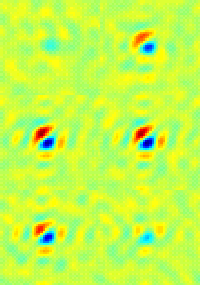 Purpose. The standard approach to generalize the
white-noise technique to neural systems with multiple inputs
consists of using a spatio-temporal white noise stimulus. A
drawback of this methodology is that the input space to be explored
is huge, and only a sparse coverage can be achieved in limited time.
We propose a new discrete-time reverse correlation technique that
effectively reduces the dimension of the input space, yielding
higher signal to noise ratios. This is achieved by exploiting
a priori knowledge about the spatial tuning properties of the
neuron. Results. We first select a set S of
M orthonormal images of size N^2 pixels. The idea is to have M
<< N^2 and use previous knowledge about the neuron's spatial
tuning to select an appropriate input space. An input image
sequence is generated by selecting, at each time, a random element
from S. We prove that the projection of the receptive field
onto the subspace spanned by the set S can be estimated based
on measurements of the crosscorrelation between the input image
sequence and the cell's output. The technique can also be applied
to systems that can be modeled as a linear receptive field followed
by a static nonlinearity. Examples are shown where S is a
subset of the complete two-dimensional discrete Hartley basis
functions. Conclusions. A simple reverse
correlation scheme that only requires the generation of a
fixed number of images can be used to identify quasi-linear
visual neurons. Prior knowledge of the spatial tuning of the cell
can be incorporated in the selection of an effective set of stimulus
images. We are currently applying this technique to the analysis of
V1 simple cells.
Purpose. The standard approach to generalize the
white-noise technique to neural systems with multiple inputs
consists of using a spatio-temporal white noise stimulus. A
drawback of this methodology is that the input space to be explored
is huge, and only a sparse coverage can be achieved in limited time.
We propose a new discrete-time reverse correlation technique that
effectively reduces the dimension of the input space, yielding
higher signal to noise ratios. This is achieved by exploiting
a priori knowledge about the spatial tuning properties of the
neuron. Results. We first select a set S of
M orthonormal images of size N^2 pixels. The idea is to have M
<< N^2 and use previous knowledge about the neuron's spatial
tuning to select an appropriate input space. An input image
sequence is generated by selecting, at each time, a random element
from S. We prove that the projection of the receptive field
onto the subspace spanned by the set S can be estimated based
on measurements of the crosscorrelation between the input image
sequence and the cell's output. The technique can also be applied
to systems that can be modeled as a linear receptive field followed
by a static nonlinearity. Examples are shown where S is a
subset of the complete two-dimensional discrete Hartley basis
functions. Conclusions. A simple reverse
correlation scheme that only requires the generation of a
fixed number of images can be used to identify quasi-linear
visual neurons. Prior knowledge of the spatial tuning of the cell
can be incorporated in the selection of an effective set of stimulus
images. We are currently applying this technique to the analysis of
V1 simple cells.
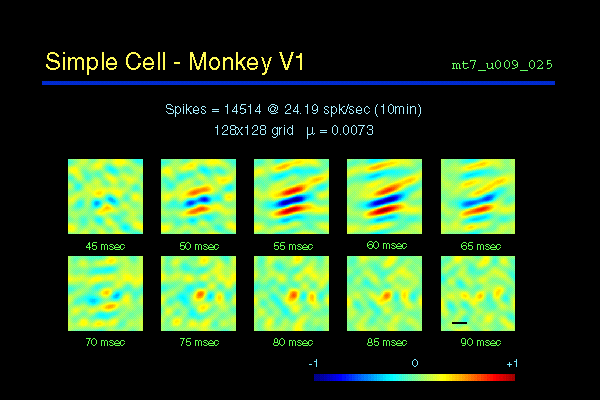
A slide from my ARVO talk...